
Have you ever wondered what would actually happen if you saved a little more each month – or spent a little less?
Most Canadians don’t struggle with money because they’re careless or lazy. They struggle because the future feels fuzzy. Saving for retirement, emergencies, or even next year’s vacation can feel like trying to imagine the weather ten years from now. Too many unknowns. Too many variables. Too much math.
The good news? You don’t need a crystal ball. You just need a simple way to ask better questions.
Today, we’re going to talk about the power of the “what if?” – and how this one small shift in thinking can quietly transform your financial life. No jargon. No guilt. No miracle promises. Just practical steps, Canadian-friendly tools, and a little humour along the way.
The Accidental Magic of “What If?” Thinking
Way back in 1988, I took a training course in a fancy new computer program called Lotus 1-2-3. At the time, it felt like learning how to fly a spaceship. The program used something revolutionary called spreadsheets.
The real magic wasn’t the rows or columns – it was the ability to run a “what if” scenario.
You could change one number and instantly see the result. Before computers, this kind of analysis took days. With spreadsheets, it took seconds. That one feature quietly changed how businesses planned, forecasted, and budgeted.
Fast forward a few decades, and spreadsheets are everywhere. Microsoft Excel, Google Sheets, and even budgeting apps all use the same basic idea.
Here’s the important part: a household budget is nothing more than a simple “what if” machine.
Actionable Step
Start thinking of your money as a series of choices, not a fixed outcome. Every choice is a “what if?” waiting to be explored.
Your Budget Is Just a Story You’re Telling Yourself
Most people think a budget is restrictive. Like a financial diet that bans joy.
In reality, a budget is just a story about what happens next.
Let’s break it down into three very common “what if” scenarios.
What If I Spend More Than I Make?
This one is easy to predict. Credit cards fill the gap. Lines of credit pick up the slack. Stress quietly moves in and brings snacks.
Debt isn’t a moral failure. It’s just math. Spend more than you earn, and the difference has to come from somewhere.
What If I Pay My Bills and Spend the Rest?
This is where many Canadians live. Bills are paid. Life is enjoyed. Dinners out, subscriptions, small treats that make the week tolerable.
The downside? There’s no buffer. No emergency fund. No long-term plan. When life happens – and it always does – the plan collapses.
What If I Save a Little Every Month?
This is the hardest scenario to visualize because the reward is delayed. You don’t feel rich next month. You don’t feel different next year.
But under the surface, something powerful is happening.
Compounding.
Actionable Step
Write down which “what if” best describes your current approach. Awareness comes before improvement.
Why Saving Feels Invisible (Until It Suddenly Isn’t)
Saving money is boring at first. There’s no dopamine hit. No applause. No Instagram-worthy moment when you move $200 into savings.
That’s because compounding is quiet.
Compounding means your money earns money, and then that money earns more money. It’s slow at the beginning and dramatic at the end – like popcorn that waits forever and then explodes all at once.
This is where spreadsheets shine. You plug in:
-
Your monthly savings amount
-
An estimated growth rate
-
Your timeline
Suddenly, the invisible becomes visible.
This is why retirement planning, investment projections, and even pension estimates all rely on the same basic tool.
Actionable Step
Use a free Canadian calculator, like the Government of Canada’s retirement income calculator, to visualize growth: Canada.ca Retirement Income Calculator
A Real-Life “Make Me a Millionaire” Moment
When I published my second e-book, The Balance, I offered it to family for free. My cousin Erin jokingly said, “Thanks – now make me a millionaire.”
So I did what any spreadsheet-loving nerd would do.
I built a scenario.
By entering a few basic assumptions – age, income, savings rate, and a reasonable growth estimate – you can map out a financial future. The funny part? I didn’t even know all her details.
And yet, the numbers still told a story.
Not a guarantee. Not a promise. Just a possibility.
The spreadsheet showed that yes, it was absolutely possible for Erin to reach seven figures by age 65 – not by winning the lottery, but by following a boring, repeatable process.
Actionable Step
Focus on what you can control: how much you save and how consistently you save it.
You Don’t Need to Understand Math – You Need to Trust the Process
Here’s the part most people get wrong.
You don’t need to understand spreadsheets, formulas, or financial theory to succeed.
You need belief.
Belief that:
-
Saving regularly works
-
Investing patiently works
-
Compounding rewards consistency, not brilliance
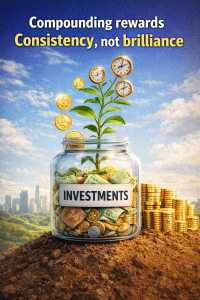
Think of it like planting a tree. You don’t dig it up every week to check the roots. You water it, protect it, and let time do its thing.
This mindset is the foundation behind simple systems like those explained in Water Barrel and The Balance. Small actions. Repeated faithfully. Over a long time.
Actionable Step
Automate one savings transfer this week – even if it’s small.
Real Canadians, Real Choices: Meet Sarah and Mike
Sarah and Mike live in Ontario. Two kids. Two incomes. Zero time.
For years, they told themselves they’d “get serious later.” Later became expensive car repairs. Later became rising grocery bills. Later became stress.
Eventually, they tried something radical.
They saved 10% first.
Not perfectly. Not every month. But consistently enough that something clicked.
They didn’t change their lifestyle overnight. They changed their system.
They used their bank’s free budgeting app, tracked spending categories, and asked better “what if” questions.
What if we ate out one less time?
What if we redirected tax refunds?
What if we increased savings when raises came?
Their finances didn’t feel tight anymore. They felt intentional.
Actionable Step
Explore the free budgeting tools offered by your Canadian bank or visit ManageYourMoney.ca’s budgeting resources.
Small Changes That Actually Move the Needle
You don’t need extreme solutions. You need sustainable ones.
-
Increase savings by 1% when income rises
-
Direct tax refunds into savings or RRSPs
-
Build an emergency fund before chasing high returns
-
Review spending once per month – not daily
These aren’t dramatic moves. They’re effective ones.
For more practical Canadian-focused guidance, explore ManageYourMoney.ca’s saving strategies.
Actionable Step
Pick one small habit to change this month. Just one.
Tools That Help Canadians Visualize the Future
If spreadsheets feel intimidating, you’re not alone. The good news is you have options.
-
Government of Canada calculators and planners
-
Free banking apps with built-in projections
-
Simple spreadsheets designed for everyday use
The goal isn’t perfection – it’s clarity.
Actionable Step
Use one tool this month to run a “what if” scenario. Curiosity beats fear every time.
The Quiet Truth About Becoming a Millionaire
Most millionaires don’t feel rich while they’re building wealth.
They feel patient.
The spreadsheet that showed Erin could reach a million dollars wasn’t magical. It was honest. It showed that steady savings plus time can do extraordinary things.
And yes – it turns out she absolutely could hit that goal by age 65.
No hype. No hustle culture. Just math, time, and consistency.
Final Thoughts: Your Future Is a Series of Small Decisions
You don’t need to predict the future. You just need to influence it.
Every dollar you save is a vote for a calmer, more flexible life. Every “what if” you explore brings clarity instead of fear.
Start small. Stay consistent. Let compounding do the heavy lifting.
Your financial future isn’t built in one bold move – it’s built quietly, one spreadsheet cell at a time.
And that’s a pretty empowering thought.
Remember: This article provides general information and shouldn’t replace personalized financial advice. Consider consulting with a qualified financial professional for guidance specific to your situation. All investment carries risk, and past performance doesn’t guarantee future results.

 In my E-books (“Water Barrel” and “The Balance”) I discuss simple methods to live sensibly for today, take charge of your financial affairs, and invest safely for the long term. For more information please visit David Penna Amazon.
 In You Don’t Need a Budget – You Need a Plan, Canadian financial educator Jim Green shows you how to take control of your money without the endless tracking, restrictions, or shame that make most budgets collapse. This book is a practical, encouraging guide for everyday people who are tired of feeling stuck, stressed, or behind financially.
Whether you’re 25 or 55, single or supporting a family, this book helps you rebuild your financial foundation from the ground up – one clear, doable step at a time. Available on Amazon
 Retirement Reimagined For decades, Canadians have been sold a one-size-fits-all story: work hard, retire at 65, and live happily ever after on savings, pensions, and beach vacations. But for many, that story doesn’t match reality – and worse, it doesn’t even sound that appealing anymore. Available on Amazon.
Disclaimer for ManageYourMoney.ca
The information provided on ManageYourMoney.ca is intended for educational and informational purposes only. It should not be taken as financial advice. The opinions shared are those of the authors and are meant to encourage sensible financial habits and decision-making. We recommend that you do your own research or consult a certified financial advisor before making any financial or investment decisions. All investments come with risks, and there is no guarantee of success. Past performance is not a reliable indicator of future results. Always consider your personal financial situation and risk tolerance before pursuing any investment opportunities.
As always, we are not a qualified financial advisors. We just relate financial management to our own experience which may not resemble yours at all. Advice is frequently worth exactly what you paid for it. Most of ours came from expensive experiences.
Please share your thoughts in the comment section below.
